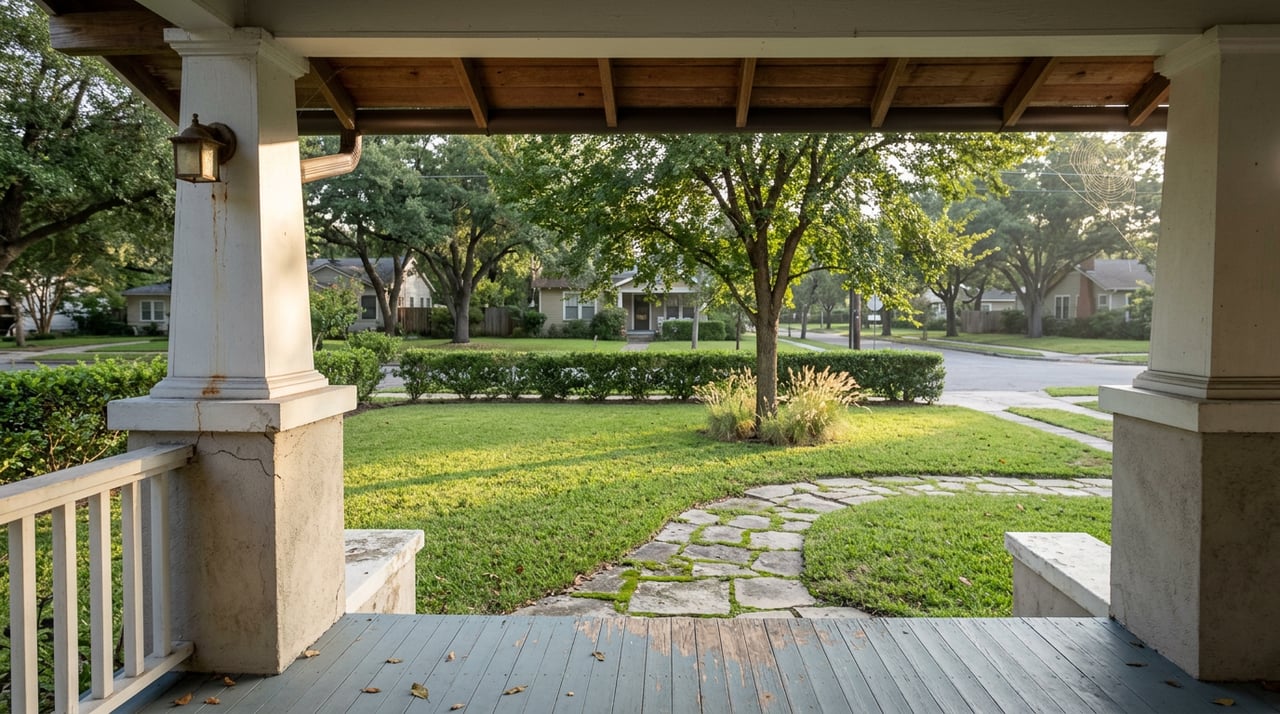
On a Saturday in November, Big Stacy Pool is still doing its normal work. The spring that feeds it keeps the water at its usual temperature no matter the season, and a few regulars are doing laps before the sun clears the tree line. Two blocks north, something less usual is happening. A woman is setting up a folding table of ceramics on her own front lawn on Fairview Park Drive. A teenager from Ann Richards School is taping a row of paintings to a fence. By eleven, the sidewalks that carry dog walkers and joggers most Saturdays are carrying something else: people with paper maps, walking slowly, stopping at houses.
This is the Travis Heights Art Trail, and if you live in the neighborhood you already know the shape of it. What's easy to miss, even after watching it happen for years, is who's actually running the thing. It isn't a gallery. It isn't the city. It isn't a chamber of commerce trying to drive foot traffic to South Congress. Every studio, every folding table, every open garage on the route belongs to an artist who lives here, and the event itself is organized by those same artists, year after year, without ever getting handed off to someone who'd professionalize it.
A tradition that stayed homemade
Last fall's edition was the 23rd, held over two days in early November with more than 70 artists and arts groups spread across 19 locations in the neighborhood. It's free to attend, self-guided, and has been described by the organizers as the longest-running artist and studio tour in Austin. That kind of longevity usually comes with some kind of institutional takeover: a sponsor logo on the map, a curated jury, an entry fee to keep out the noise. None of that happened here. The Trail is still, by its own description, the only neighborhood art show run entirely by the artists who exhibit in it.
That governance detail explains something else about the day that's easy to miss if you're only there for the pottery. Alongside the working painters and printmakers, the Trail has made room for groups that have nothing to do with commercial art at all. The Ann Richards School Art Department brings work from students in grades 6 through 12, painting and drawing alongside ceramics, knitting, and jewelry. Art From the Streets, which nurtures creative work among people experiencing homelessness, sets up a stop of its own. So does Adventurers Academy of Lifelong Learning, which shows work by adults with intellectual and developmental disabilities. A juried show would sort these groups out in the first round. Travis Heights put them on the same map as a career artist with 20 years of practice, because the people who built the Trail decided that's what a neighborhood art show should look like.
If you've walked the Trail before without thinking much about who organizes it, that's the detail worth carrying into the next one: the reason it still feels like a neighborhood and not a festival is that nobody with a marketing budget ever got a vote.
The walk between the stops
The physical route rewards slowing down, and the neighborhood's geography does some of that work for you. Little Stacy Park and Big Stacy Park sit at opposite ends of the Blunn Creek Greenbelt, a shaded loop of about a mile that connects them under a canopy of live oaks and cedar elms. Along the path, metal markers identify individual trees, enough that you can settle a genuine argument between an elm and a cedar elm if you stop to read them. Near the Travis Heights Elementary end, the trail crosses a pedestrian bridge that regulars have taken to calling the Frank Lloyd Wright bridge, more for its lines than any actual connection to the architect.
Little Stacy itself has more infrastructure packed into 6.73 acres than its size suggests: a historic 1929 wading pool, tennis and volleyball courts, a playground, and picnic tables under mature trees. The city bought the land for the park from the Stacy Realty Company that same year for $17,150, a number that means little on its own except as a reminder of how long this particular stretch of ground has been doing exactly the job it does now. Big Stacy, despite the name, is the smaller of the two parks, known mainly for its spring-fed pool that stays open and swimmable year-round.
None of this is officially part of the Art Trail route. But because the Trail's 19 stops are scattered through the residential streets on both sides of the greenbelt, most people walking it end up passing through the parks anyway, pool towels and paper maps crossing paths without either group paying much attention to the other. It's a small thing, but it's the kind of overlap that only happens in a neighborhood small enough that the art show and the swim schedule share the same three blocks.
Where the day starts and ends
South Congress sits at the western edge of Travis Heights and functions as the neighborhood's front porch, close enough to make a coffee run or a dinner reservation part of the same outing as an afternoon on the Trail. Jo's Coffee is the standard morning stop before the crowds thicken. Perla's, known for its oak-shaded patio and oyster list, is the easy choice for later in the day. June's All Day covers the wine-and-small-plates version of the same idea.
The newest addition to that stretch is The Greek Bar, which opened on February 26, 2025, at 534 East Oltorf Street, a few blocks from where the Trail runs. It comes from husband-and-wife owners Dimitri Karabinas and Daphne Greer, with a menu built by executive chef Brian Beach, previously of the Greek restaurant Kokkari. Greer had spent time managing dining rooms at Austin Proper's Peacock and at Juniper before deciding the city was missing something specific.
"I recognized a strong demand for Mediterranean cuisine in Austin," Greer said of the decision to open the restaurant. The space leans into that idea with original saltillo tile, terra cotta details, and a covered back patio designed with Luke Havekes, an interior designer whose work has appeared in Architectural Digest. It's open four to ten most evenings, with weekend brunch still in the works. For a neighborhood whose culinary reputation runs mostly to Tex-Mex and taco trucks, a family-owned Greek kitchen a short walk from Little Stacy Park is its own small sign of how the area keeps adding to itself without losing the parts that made it worth living in to begin with.
What the day is actually about
None of this is a pitch to visit Travis Heights. If you're reading this, you probably already live close enough to walk it. But there's a version of the Trail that a first-time visitor sees and a version that a longtime resident understands, and the difference comes down to that governance detail: the people showing their work are the same people who decided, decades ago, that nobody else would run the show. That choice is why a high school ceramics table and a career printmaker's studio can sit three doors apart without either one feeling out of place, and why the whole event still runs on volunteer effort and neighborhood goodwill instead of sponsorship decks.
It's worth walking the Trail with that in mind, not as a piece of trivia but as a lens. The same instinct that's kept an art show artist-run for 23 years is the instinct that shapes a lot of what makes this particular stretch of South Austin feel the way it does: a preference for the homemade version over the managed one, even when the managed version would probably be easier.
If you're weighing a move into a neighborhood like this one, or thinking about what your own home might be worth to someone drawn to that same homemade quality, Lee Bullock brings both a longtime eye for Central Texas real estate and a working artist's read on what actually gives a place its character. Let's Connect.